
1. Introduction
Multiple myeloma is a clonal plasma-cell malignancy of the bone marrow and one of the most common hematologic cancers worldwide, accounting for roughly a tenth of hematologic malignancies.1 Its burden is unevenly distributed, and access to diagnosis and treatment differs sharply between high- and middle-income settings.2 In Mexico, the disease carries a prevalence of about 2.1 per 100,000 and generates considerable functional, social, and economic costs for patients and their families.3 Autologous hematopoietic stem cell transplantation (HSCT) is a central part of treatment, restoring marrow function after high-dose therapy.4,5
The diagnosis of multiple myeloma, the decision to proceed to transplantation, and the transplant itself are recognized stressors. Depression, anxiety, fatigue, and reduced quality of life have been described before, during, and after HSCT.6–9 Reported figures vary considerably: moderate-or-greater depressive symptoms were present in 6% of patients before HSCT in one cohort,7 while another longitudinal study found that the proportion meeting its depression-screening threshold increased from 15.6% before HSCT to 37.8% by day +8 during hospitalization.9 A survey of 200 patients within six months of a lymphoma or myeloma diagnosis found clinically significant depression symptoms in 27.5% (95% CI, 21.6–34.3), with lower financial satisfaction and lower social support associated with higher odds of depression.10 Multiple myeloma is the leading indication for autologous HSCT, and patients remain on treatment indefinitely, so distress in this group is sustained rather than confined to the transplant admission.11 Part of the variation between reports reflects real differences between populations, but it also reflects the timing of assessment, the instruments used, and the thresholds chosen to define depression; baseline anxiety/depressiveness has also been associated with poorer health-related quality of life across subsequent treatment assessments.12 Transplant candidates are, moreover, a selected group: they must meet clinical criteria to be considered fit for a demanding procedure, which may lower the frequency of psychiatric symptoms relative to the wider oncology population.
Our earlier report presented PHQ-9 and GAD-7 findings from a mixed-diagnosis HSCT cohort that included 50 patients with multiple myeloma.13 The present cross-sectional secondary analysis examines an expanded, disease-specific autologous-HSCT cohort, with the primary aim of estimating pre-transplant depressive-symptom prevalence and the secondary aim of exploring psychosocial associations. We used the PHQ-9 as the screening instrument.14
2. Methods
2.1. Study design and setting
This was a single-center, observational, cross-sectional secondary analysis of one routine pre-transplant psychiatric assessment per participant, carried out at a tertiary teaching hospital with an established autologous HSCT program. Eligible assessments occurred from June 2023 through April 2026. Assessments performed between June 2023 and September 2025 (68 participants) were identified retrospectively from clinical records, whereas assessments performed between October 2025 and April 2026 (15 participants) were captured prospectively during the study execution period. The same routine pre-transplant psychiatric assessment procedure, including administration of the PHQ-9 and the GAD-7 by the attending psychiatrist, was used throughout; data abstraction was completed in April 2026. Because each participant contributed a single assessment at one pre-transplant point, the design is cross-sectional irrespective of whether the record was captured retrospectively or prospectively. The study followed the STROBE recommendations for observational research, and the completed checklist is provided as a separate supplementary file.
2.2. Participants
The analysis included adults with confirmed multiple myeloma who completed the PHQ-9 and GAD-7 during routine pre-transplant psychiatric assessment and subsequently underwent autologous HSCT. Patients who did not attend the psychiatric assessment, who did not complete the PHQ-9, who had a hematologic diagnosis other than multiple myeloma, or who discontinued the transplant protocol at any stage were not analyzed. Eligibility therefore depended on subsequently completing transplantation. Sampling was consecutive and non-probabilistic. The psychiatric assessment formed part of the pre-transplant protocol and preceded conditioning in every case, but the interval between assessment and conditioning was not recorded and cannot be reported.
Numerical participant accounting is given in Table 6. The number of patients with multiple myeloma referred for pre-transplant psychiatric assessment during the study period, and the number who did not attend, could not be reconstructed from the available records. The source denominator is therefore unavailable, and selection bias arising from non-attendance cannot be excluded. Throughout this report, the study population is described as patients assessed before autologous HSCT who subsequently underwent transplantation.
2.3. Relationship to a previously published cohort
This analysis draws on the institutional psycho-oncology database that also supplied a previously published study from our center.13 That report was a retrospective, cross-sectional record review of patients evaluated by the psychiatry service as part of the HSCT protocol between January 2024 and November 2025; it examined depressive and anxiety symptoms at the initial psychiatric assessment across hematologic diagnoses and transplant types, analyzed 103 patients, and included 50 patients with multiple myeloma (48.5% of that sample). Its stated objective was descriptive, and it did not examine psychosocial characteristics.
Participant-level linkage between the two datasets was not performed, because the earlier report was assembled through an independent chart review rather than from the present analytic file. The exact overlap therefore cannot be determined. Of the 83 participants analyzed here, 65 were assessed within the earlier report’s review window and 18 were assessed outside it (8 between June and December 2023 and 10 between December 2025 and April 2026). The earlier report included 50 patients with multiple myeloma; accordingly, no more than 50 of the present 83 participants could overlap with that report, and at least 33 were not included in it. Eighteen of those 33 are new by assessment date alone; the remaining minimum of 15 follows from the difference between the 65 present participants assessed within the earlier review window and the 50 patients with multiple myeloma reported previously. Because participant-level linkage was unavailable, these figures should be interpreted as bounds rather than exact matches. Table 6 reports this derivation.
One analysis overlaps substantively with the earlier report: the correlation between PHQ-9 and GAD-7 scores, which was also positive in the mixed-diagnosis cohort.13 The prevalence estimates presented here are disease- and procedure-specific and were not reported previously, and none of the psychosocial variables was examined in the earlier report.
2.4. Measurements
Depressive symptoms were assessed with the PHQ-9, a self-administered instrument based on DSM criteria and widely used to screen for and grade depression.14,15 We used a PHQ-9 score of 10 or higher as the primary indicator because this is the conventional threshold established in the original validation study; diagnostic performance at this cut point varies across settings and populations.14,16 A score of 5 or higher was used as a secondary threshold indicating at least mild depressive symptoms; both thresholds were specified in the study protocol before the analysis. Symptom severity was classified as minimal or absent (0–4), mild (5–9), moderate (10–14), moderately severe (15–19), or severe (20–27).14,17 PHQ-9 results are described throughout as screening-defined symptom levels, not as diagnoses of depression.
Both instruments were administered in Spanish, in the versions in routine clinical use at the institution. The Spanish PHQ-9 has been validated for depression screening in Mexican and other Latin American populations.18–20 The GAD-7 is a seven-item measure of generalized anxiety21 for which a Spanish cultural adaptation was developed and validated in Spain.22 GAD-7 scores were used only to examine the relationship between anxiety and depressive symptoms.
Sociodemographic, clinical, and psychosocial variables were collected from the clinical record and the psychiatric assessment: age, sex, employment status, marital status, transplant type, socioeconomic stratum, perceived social support, self-concept, sense of meaning in life, and group belonging. Each participant was identified by a non-repeating numeric code, and no directly identifying data were recorded.
Psychosocial characteristics were abstracted from routine psychiatric documentation rather than measured using validated psychosocial scales. Categories reflected the assessing psychiatrist’s recorded judgment according to the operational definitions set out in the study protocol: social support was recorded as adequate or insufficient according to the evaluator’s assessment of the people, groups, and institutions available to the patient for emotional, social, economic, or practical help; self-concept as positive or negative according to the patient’s expressed perception of their own attributes, abilities, emotions, and values; meaning in life as present or absent/void according to whether the patient described life as having a discernible purpose; and group belonging as present or absent according to whether the patient identified as a member of a social, religious, or cultural group. These categories are therefore treated as exploratory clinical descriptors rather than psychosocial measurements.
Employment status was recorded as a binary variable reflecting whether the participant was in paid work at the time of assessment, and we use the terms currently employed and not currently employed accordingly. Of the 28 participants classified as not currently employed, 21 were retired or drawing a pension and 7 were homemakers; no participant was recorded as involuntarily unemployed, on medical leave, or receiving a disability benefit. The category therefore denotes absence from the paid workforce, predominantly through retirement, and not job loss.
2.5. Sample-size determination and precision
A conventional single-proportion calculation using p=.50, 95% confidence, and a margin of error of five percentage points produced a precision benchmark of 385 participants; this calculation was documented in the study protocol before cohort assembly.23 The value p=.50 was selected solely as the conservative maximum-variance assumption and did not represent an expected prevalence or a scientific hypothesis. The available institutional cohort comprised all 83 eligible patients, and the achieved precision is therefore presented using exact 95% binomial confidence intervals.
2.6. Statistical analysis
Because the PHQ-9 and GAD-7 distributions were strongly skewed and concentrated at zero, continuous variables were summarized as median and interquartile range (IQR); means, standard deviations, and ranges are given as secondary summaries. Categorical variables were summarized as counts and percentages. Prevalence was reported as a proportion with an exact (Clopper-Pearson) binomial 95% CI.
Because only 3 participants met the PHQ-9 ≥10 threshold and 6 met the PHQ-9 ≥5 threshold, all sociodemographic and psychosocial comparisons were exploratory and hypothesis-generating. Fisher exact tests were used for categorical comparisons, with estimable odds ratios reported as conditional maximum-likelihood estimates alongside exact 95% confidence intervals. Where a zero cell left the conditional estimate undefined, the odds ratio is reported as not estimable and only the corresponding exact interval bound is given. Because odds ratios and risk ratios are distinct effect measures, odds ratios are reported and interpreted here strictly as measures of odds rather than risk.24,25 No adjustment was made for multiple exploratory comparisons, and no multivariable model was fitted. Continuous distributions were compared with the Mann-Whitney U test, and the relationship between PHQ-9 and GAD-7 scores with the Spearman rank correlation coefficient. Two-sided P values are reported throughout.
Available-case analysis was used for each psychosocial variable; missing or “not assessed” observations were excluded and were not recoded as absence of the characteristic. Analyses were performed in Python 3.14.4 with SciPy 1.17.1, using binomtest for exact binomial proportions and confidence intervals, fisher_exact for Fisher exact tests, contingency.odds_ratio (kind=“conditional”) for conditional maximum-likelihood odds ratios and their exact confidence intervals, spearmanr for rank correlations, and mannwhitneyu for group comparisons.
3. Results
3.1. Cohort characteristics
We analyzed 83 patients with multiple myeloma. The median age was 59 years (IQR, 53–65; mean, 57.9; SD, 9.9; range, 26–76). The sample was balanced by sex, with 42 women (50.6%) and 41 men (49.4%), and all participants underwent autologous transplantation. Sociodemographic, clinical, and psychosocial characteristics are shown in Table 1, with the available denominator and missing count for each psychosocial variable, and descriptive statistics for continuous variables in Table 2. Meaning in life and group belonging were recorded for 44 and 34 participants, respectively, and are reported descriptively only.
3.2. Prevalence of depressive symptoms
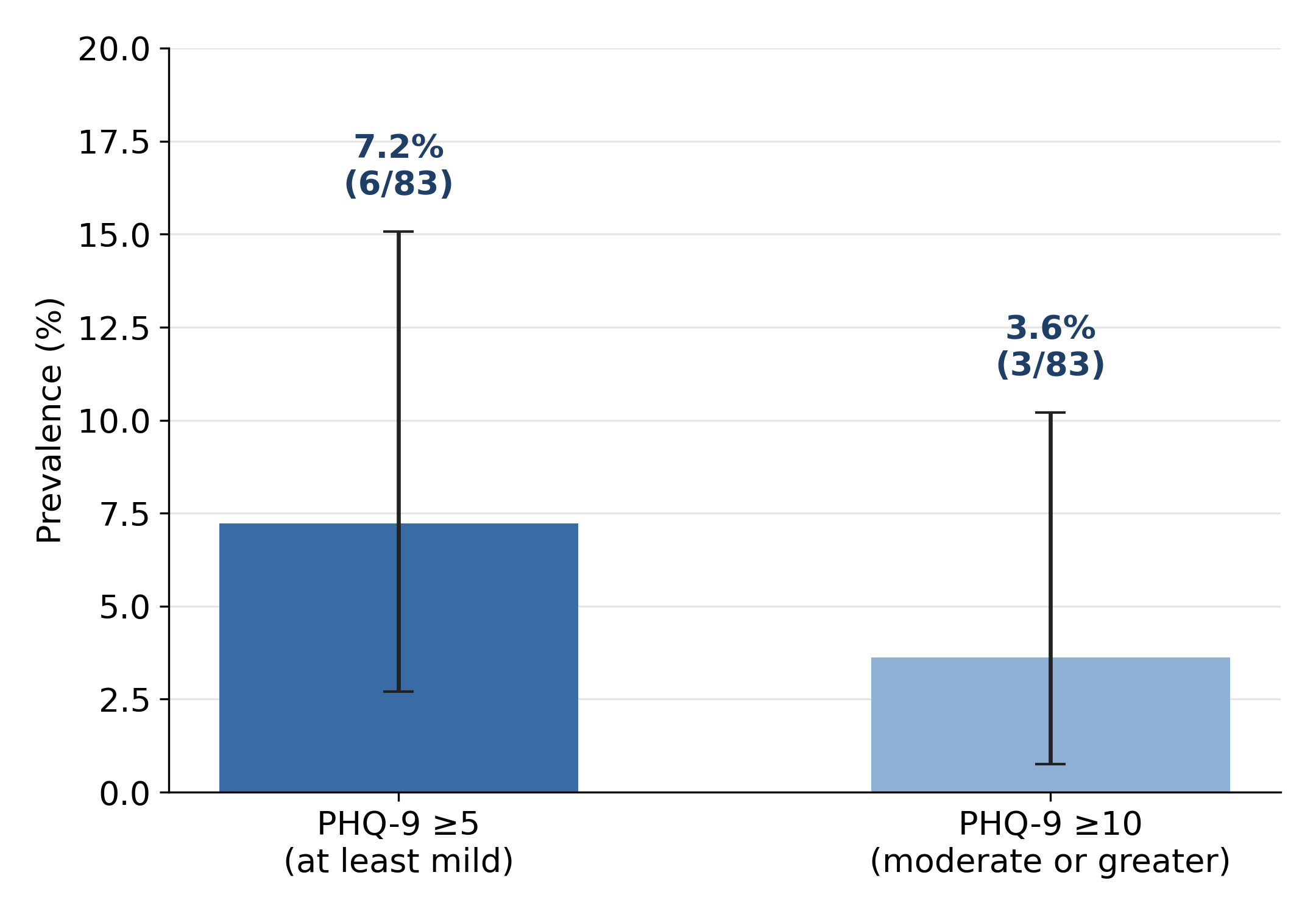
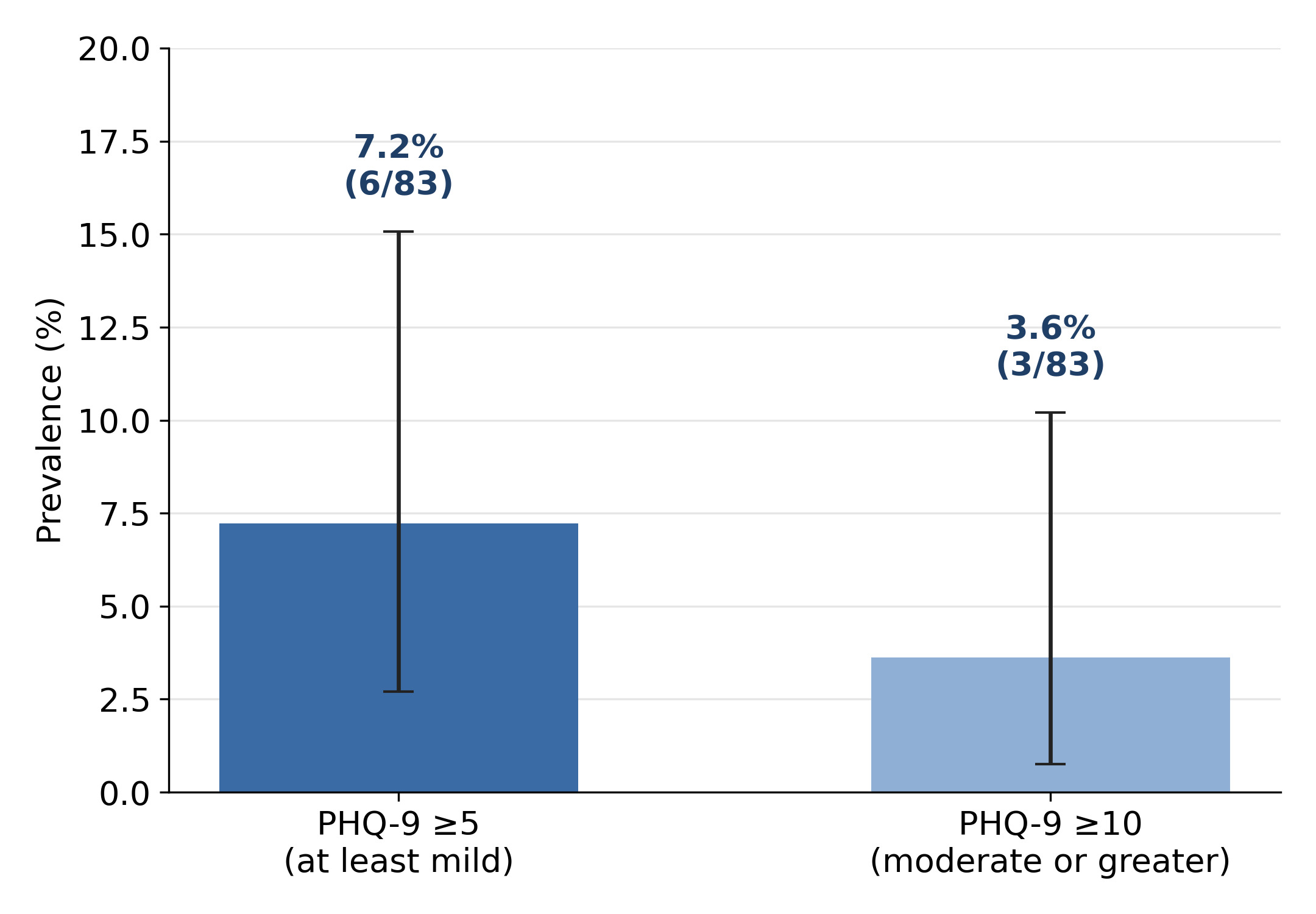
PHQ-9 scores of 10 or higher were present in 3 of 83 participants (3.6%; 95% CI, 0.8–10.2). Using the secondary threshold, at least mild depressive symptoms (PHQ-9 ≥5) occurred in 6 of 83 participants (7.2%; 95% CI, 2.7–15.1). No participant scored in the severe range (0 of 83; 95% CI, 0.0–4.3), and the median PHQ-9 score was 0 (IQR, 0–0; range, 0–15) (Figure 1).
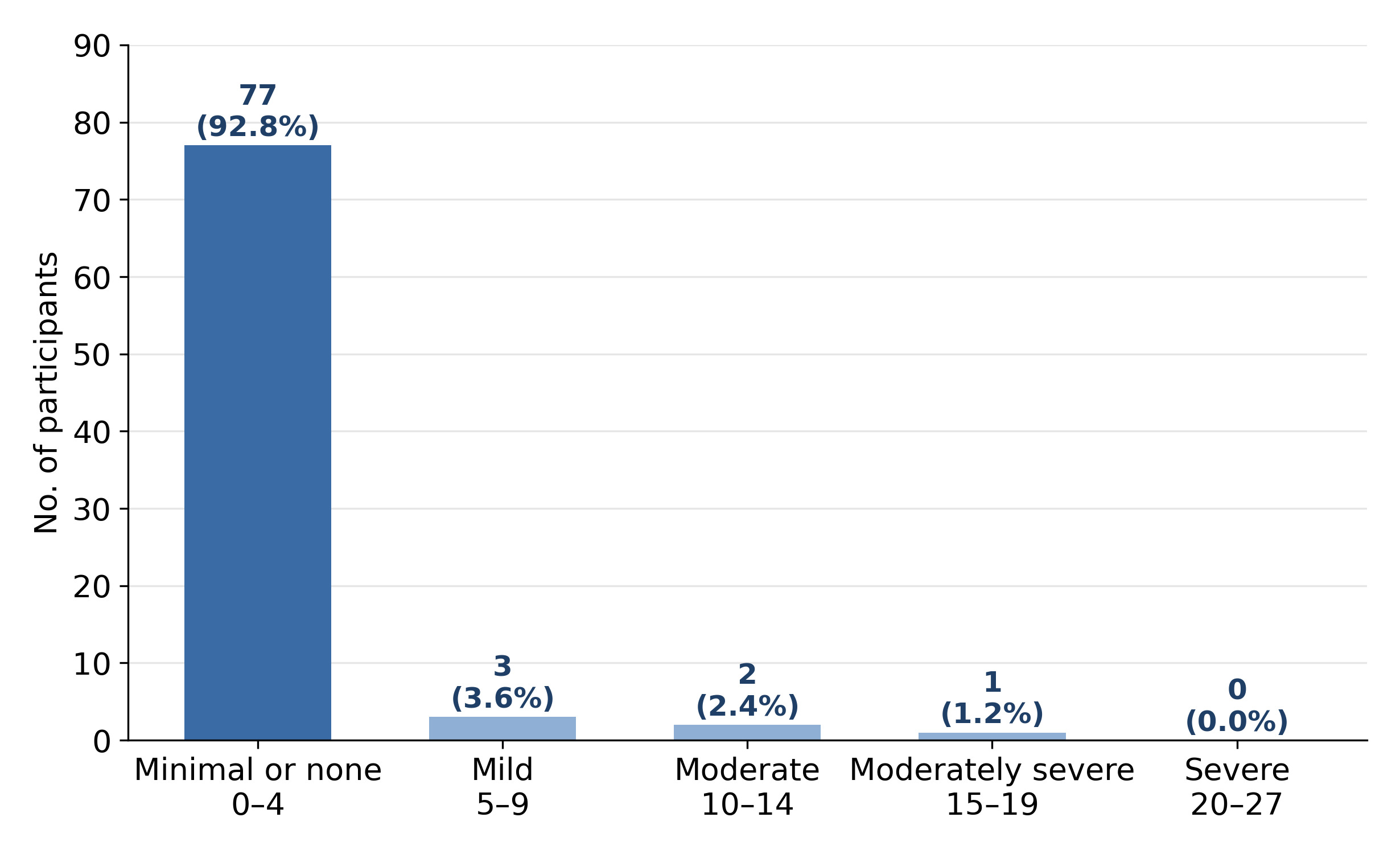
Most participants fell in the minimal-or-absent category, and counts thinned quickly across the severity bands (Table 3, Figure 2).
._phq-9_indicates_.png)
3.3. Exploratory associations
With 3 and 6 events at the two thresholds, the bivariate results below are exploratory. At the PHQ-9 ≥10 threshold, no sociodemographic or psychosocial variable was associated with depressive symptoms, and every interval was wide (Table 4). At the PHQ-9 ≥5 threshold, at least mild depressive symptoms were observed in 5 of 28 participants not currently in paid employment (17.9%) and in 1 of 55 currently employed participants (1.8%) (odds ratio, 11.38; 95% CI, 1.18 to 565.16; P=.02, Fisher exact test) (Table 5). Participants not currently employed were older than those in paid work (median, 63 vs 57 years; P<.001, Mann-Whitney U test). Age did not differ between participants above and below the PHQ-9 ≥10 threshold (median, 57 vs 59 years; P=.72).
After the 4 participants whose self-concept was not assessed were excluded, at least mild depressive symptoms were recorded in 1 of 7 participants with negative self-concept and in 5 of 72 with positive self-concept (odds ratio, 2.20; 95% CI, 0.04 to 25.39; P=.44); the previous estimate of 2.37 had placed the unassessed participants in the reference category.
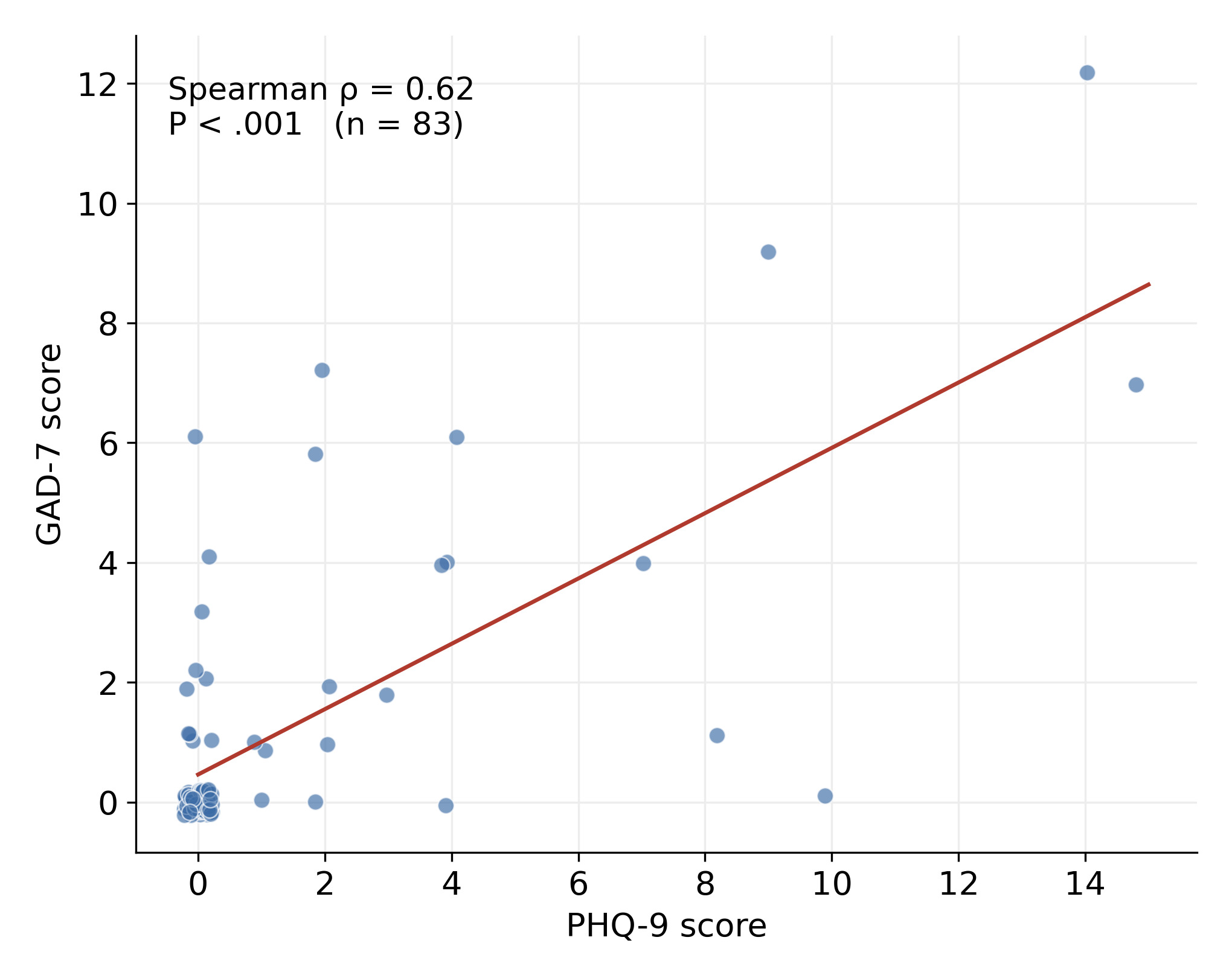
PHQ-9 and GAD-7 scores were positively correlated (Spearman ρ=0.62; P<.001) (Figure 3). This finding describes covariation between two screening scores and does not establish diagnostic comorbidity.
._points_are_j.png)
4. Discussion
In this single-center sample of patients assessed before autologous HSCT for multiple myeloma who subsequently underwent transplantation, screening-defined depressive symptoms were infrequent: 3.6% (95% CI, 0.8–10.2) at a PHQ-9 threshold of 10 and 7.2% (95% CI, 2.7–15.1) at a threshold of 5, with no participant in the severe range and a median score of zero. The present analysis extends the earlier mixed-diagnosis report by providing disease-specific estimates in an expanded multiple-myeloma cohort and by examining additional psychosocial characteristics.13
These figures sit at the low end of what earlier work has reported. Mosher et al. noted that depression and fatigue are among the symptoms transplant recipients most often report,6 and Artherholt et al. found that 6% of patients reported moderate-or-greater depressive symptoms before transplantation, a proportion that rose to 31% at 6 to 7 weeks after transplantation.7 El-Jawahri et al. found a marked decline in quality of life during HSCT hospitalization, while the proportion meeting their depression-screening threshold increased from 15.6% before HSCT to 37.8% by day +8.9 Higher estimates come from cohorts assessed closer to diagnosis: Odejide et al. reported clinically significant depression symptoms in 27.5% of patients within six months of a lymphoma or myeloma diagnosis.10 Fischer et al. found that patients with lower baseline anxiety/depressiveness had better global health status and broader health-related quality-of-life profiles across follow-up assessments.12 Several things likely explain why our estimate is lower. The first is timing. Depressive symptoms in patients with chronic hematologic disease are not stable across the treatment course; studies that assess patients at diagnosis, during hospitalization, or in protective isolation tend to capture higher rates than those, like ours, that assess ambulatory candidates in more stable phases.8,9 A low screening prevalence at one point does not rule out symptoms at another.
The second is selection. Reaching transplant candidacy requires meeting clinical criteria and tolerating a demanding procedure, so patients who get this far may represent a subgroup with better functional status and stronger ties to care; eligibility for the present analysis also required completing transplantation, which narrows the sample further. The third is that every analyzed patient underwent autologous transplantation, which further narrows the population to which these estimates apply.11 Finally, the PHQ-9 is a brief screening tool, not a diagnostic interview; a score below threshold reflects screening status, not the absence of a clinically meaningful inner experience.
The low frequency should not be read as an absence of distress. Depressive symptoms in cancer are not an isolated phenomenon but part of a broader set of biological, psychological, and social determinants; a systematic review by Ikhile et al. organized associated risk factors across cancer-specific, biological, psychological, and social domains.26
An exploratory association was observed between employment status and PHQ-9 scores of 5 or higher. However, the comparison was based on only six events, produced a highly imprecise estimate, and arose among several exploratory comparisons. Employment status may reflect several different functional and socioeconomic circumstances, and in this sample the category was composed entirely of retired participants and homemakers, who were also older than those in paid work, rather than of people who had lost work through illness; the present data cannot identify the underlying mechanism. The finding should therefore be examined using prespecified employment categories in a larger cohort.
PHQ-9 and GAD-7 scores covaried, although both distributions showed marked floor effects, with median scores of zero. The coefficient should therefore be interpreted as an association between screening scores rather than evidence of diagnostic co-occurrence, particularly as a similar correlation was already present in the partially overlapping mixed-diagnosis cohort.13
5. Limitations
This study has several limitations. The cross-sectional, single-timepoint design cannot establish causation or track how symptoms evolve across the transplant course. Only 3 participants met the primary threshold and 6 the secondary threshold, so all bivariate analyses are exploratory and their effect estimates imprecise. The source denominator was unavailable: the number of patients referred for pre-transplant psychiatric assessment, and the number who did not attend, could not be reconstructed, so selection bias cannot be excluded. Participant-level linkage with the previously published cohort was not possible, and the overlap is therefore reported as bounds rather than as exact participant-level matches. Recruitment at a single center limits generalizability, and the inclusion of only autologous transplant recipients narrows the scope further. The PHQ-9, though useful for screening, does not replace a structured clinical interview. Psychosocial characteristics were derived from routine, nonstandardized clinical documentation, and some fields, particularly meaning in life and group belonging, were incompletely recorded. These findings should therefore be interpreted as exploratory descriptions rather than validated psychosocial measurements.
6. Conclusions
PHQ-9 scores in the moderate-or-greater range were infrequent in this selected single-center sample of patients assessed before autologous HSCT for multiple myeloma. That result does not lessen the case for routine mental-health screening in this population, which rests on the clinical consequences of unrecognized depression rather than on the present prevalence estimate. The exploratory employment-status finding identifies a question for larger studies but should not be interpreted as a confirmed psychosocial correlate. Longitudinal studies with larger samples, assessing patients before, during, and after transplantation, would help clarify how affective symptoms develop and which patients are most vulnerable.
Conflict of Interest
The authors declare no conflicts of interest.
Ethics Approval and Consent
This study was approved by the Institutional Review Board / Local Research and Ethics Committee of Centro Médico Nacional “20 de Noviembre”, ISSSTE (approval/registration ID CMN.RPI.155.2025). The study was conducted in accordance with the Declaration of Helsinki and the Mexican Official Standard NOM-012-SSA3-2012. All participants provided written informed consent. All data were anonymized prior to analysis, and each participant was identified only by a non-repeating numeric code.
Data Availability
De-identified data are not publicly available due to ethical and privacy restrictions but may be obtained from the corresponding author upon reasonable request and with approval from the institutional review board.
Trial Registration
This study is not a clinical trial and therefore did not require trial registration.
Protocol Registration
The study protocol was registered with the local research and ethics committee under CMN.RPI.155.2025. No external protocol registration was required for this observational design.
Reporting Guidelines
This study was conducted and reported in accordance with the STROBE guidelines for cross-sectional studies.
Funding
This research received no external funding.
Acknowledgments
None.
AI Tool Use Disclosure
Artificial intelligence tools were used for language editing, formatting, and for reproducing the statistical analyses reported in the revised manuscript. All analyses were re-executed against the source data file, and all content was reviewed and verified by the authors.
Related Publication Disclosure
This manuscript is a secondary, disease-specific analysis of a partially overlapping institutional HSCT cohort previously reported by Salazar-Rodríguez A, Moya-Sánchez DN, Espinoza-de-Ávila EF, Arana-Luna LL, Ochoa-Madrigal MG, Vázquez-Reynoso L. Depressive and anxiety symptoms at initial psychiatric assessment in patients entering hematopoietic stem cell transplantation protocols: a cross-sectional study using PHQ-9 and GAD-7. Cureus. 2026;18(6):e111561. doi:10.7759/cureus.111561. Participant-level linkage between the two datasets was not performed. Based on cohort dates and diagnostic counts, no more than 50 of the present 83 participants could have appeared in the earlier report, and at least 33 were not included; 18 of those 33 are new with certainty by assessment date alone. The derivation is set out in Table 6 of the manuscript and in the Methods subsection “Relationship to a previously published cohort”.
Preprint Disclosure
This article has not been previously published as a preprint.
Third-Party Material Permissions
No third-party material requiring permission was used in this manuscript. All figures are original and were generated by the authors from the study data at 300 dpi.
Author Contributions (CRediT)
Project administration: María Constanza Benavides Cáceres (Lead). Validation: Elia Francisca Espinoza de Ávila (Supporting), Marta Georgina Ochoa Madrigal (Supporting), Luara Luz Arana Luna (Supporting). Data curation: Óscar Meneses Luna (Equal). Writing – original draft: Mario Antonio Téllez González (Equal), Deldhy Nicolás Moya Sánchez (Equal).