
1. Introduction
Hereditary hearing loss presents a fundamental challenge for therapeutic development: a single clinical phenotype arises from a highly heterogeneous set of genetic and biological mechanisms. More than 150 genes have been implicated in hereditary hearing loss, encompassing both syndromic and nonsyndromic forms.1 This heterogeneity directly defines the boundaries of therapeutic feasibility, because interventions that are mechanistically effective for one genetic subtype may be entirely irrelevant for another, and the degree to which cochlear architecture is preserved at the time of intervention determines whether any form of gene replacement can succeed.
The dominant clinical solution to sensorineural hearing loss, cochlear implantation, sidesteps this complexity by bypassing dysfunctional cochlear structures altogether. Rather than restoring physiological hearing, a cochlear implant converts sound into electrical signals delivered directly to the auditory nerve. In appropriately selected patients, this approach provides meaningful functional benefit, particularly for speech understanding in quiet environments. Outcomes are highly variable and depend on factors including residual neural integrity, age at implantation, duration of auditory deprivation, and rehabilitation intensity.2 Cochlear implantation is compensatory rather than restorative: it does not recreate the rich spectrotemporal coding of the normal inner ear, and it introduces a permanent foreign-body burden into a surgically challenging space. For patients with intact but nonfunctional hair cells, it also sacrifices residual natural hearing that might otherwise be preserved or recovered.
Gene therapy introduces a different therapeutic paradigm by targeting the underlying molecular defect rather than circumventing the affected structure. Advances in adeno-associated viral (AAV) vector engineering over the past decade have enabled increasingly precise delivery of genetic material to the sensory cells of the cochlea, and preclinical studies across multiple genetic models have demonstrated restoration of auditory function that would not be achievable through device-based approaches.3–5 This strategy offers the potential for physiological recovery rather than compensation, provided that the cellular substrate for such recovery remains viable. The primary barrier to clinical translation has not been conceptual but practical, requiring the development of vectors with sufficient cochlear tropism, packaging capacity for large transgenes, and safety profiles acceptable for use in young children.
Clinical translation has focused almost exclusively on OTOF-related deafness, a form of auditory neuropathy in which mutations in the otoferlin gene impair synaptic vesicle release at the inner hair cell ribbon synapse while leaving the broader cochlear architecture largely intact.6 This biological profile creates a favorable therapeutic context: hair cells are present, afferent neural connections are functional, and the disease mechanism is localized to a single synaptic protein. Restoring otoferlin expression has the potential to rescue an otherwise intact auditory system, making OTOF-related deafness a logical first target for early-phase human studies. The same cannot be said for many other genetic causes of hearing loss, in which the pathology is more diffuse, structurally destructive, or temporally narrow in its reversibility.
The divergence between what has been studied and what the broader clinical landscape contains is a defining feature of this field. Considered in isolation, the peer-reviewed literature appears narrow: a small number of early-phase studies, all targeting the same gene, with small samples, short follow-up, and no head-to-head comparisons. Clinical trial registries reveal a more active landscape, with nine unique interventional gene therapy trials identified across registries after screening and deduplication at the time of this review. The published literature is therefore a lagging indicator of clinical activity rather than a comprehensive accounting of where the field stands.
This scoping review was designed to address that gap. By systematically mapping the published human evidence alongside the broader registry-derived trial landscape, the review aims to provide an integrated picture of early clinical translation, characterize patterns of target selection and platform development, and clarify the degree to which current findings can or cannot be generalized across the heterogeneous spectrum of hereditary hearing loss. Given the small number of available human studies, early-phase trial designs, and substantial heterogeneity in interventions and outcome reporting, a scoping approach was selected to characterize the structure of the evidence rather than to estimate pooled treatment effects.7,8
2. Methods
This study was conducted as a scoping review in accordance with the Preferred Reporting Items for Systematic Reviews and Meta-Analyses extension for Scoping Reviews (PRISMA-ScR).9 A scoping approach was selected because the available human literature remains small, methodologically heterogeneous, and dominated by early-phase studies, making evidence mapping more appropriate than pooled effect estimation.8 No protocol was prospectively registered for this review.
2.1. Information Sources and Search Strategy
2.1.1. Published Literature
A structured search of a single bibliographic database, PubMed, was conducted on April 17, 2026, to identify peer-reviewed human studies of therapeutic gene transfer for hereditary hearing loss. The search combined intervention-related terms, disease-related terms, and gene-specific terms. Filters were applied for English language, publication years 2015 through 2026, and human studies. The complete PubMed search string is provided in the Supplementary Material. The decision to restrict bibliographic searching to PubMed is acknowledged as a methodological constraint that may reduce capture sensitivity for studies indexed exclusively in EMBASE, Cochrane CENTRAL, Scopus, Web of Science, or regional databases. The review is framed accordingly as a PubMed-based scoping review of the published human evidence rather than as a comprehensive multi-database evidence synthesis, and implications for capture sensitivity are addressed in the Limitations section.
2.1.2. Clinical Trial Registries
To account for publication lag and capture ongoing, completed, or unpublished interventional trials not yet represented in the peer-reviewed literature, supplementary searches were conducted across four registry sources: ClinicalTrials.gov (primary structured registry), ICTRP (global capture including ChiCTR and EU registries), the Chinese Clinical Trial Registry (ChiCTR, direct search with English and Chinese-language terms), and the European Union Clinical Trials Information System (CTIS, direct search). Iterative keyword-based strategies were structured across three complementary layers: broad condition-plus-intervention terms, gene-specific terms (OTOF, otoferlin, DFNB9, GJB2, connexin 26, DFNB1, TMC1), and platform-related terms (AAV, AAVAnc80, gene transfer, gene replacement). TMC1-directed searches returned no results in any registry source. The complete registry search strategy is summarized in Table 1.
2.1.3. Grey Literature
Conference proceedings, preprints, and industry communications were not systematically searched. This decision was made to preserve a clear evidentiary distinction between the two primary sources of evidence: peer-reviewed published human studies and formally registered interventional trials. Grey literature sources reflect preliminary, non-peer-reviewed disclosures subject to revision, selective reporting, and incomplete methodological documentation. Their inclusion would have introduced an additional evidence tier with uncertain quality characteristics, complicating the interpretive framework without proportionate gain in coverage given that the principal emerging programs are already captured through their registry records.
2.2. Eligibility Criteria
Published studies were included if they reported original human data, involved therapeutic gene transfer or gene replacement targeting hereditary or genetically defined hearing loss, and reported auditory outcomes including objective measures such as auditory brainstem response (ABR) or pure-tone audiometry (PTA), or functional outcomes such as speech perception. Studies were excluded if they were preclinical, non-human, mechanistic without a therapeutic intervention, limited to diagnostic or genetic characterization, observational, or published as reviews, editorials, or commentaries. Secondary analyses of previously reported patient cohorts that did not report new therapeutic interventions or new primary efficacy endpoints were excluded from the eligible study count but were considered as supporting evidence in the narrative synthesis.
Registry records were included if they represented human interventional gene therapy studies targeting hereditary or genetically defined hearing loss. Records were excluded if they were observational, screening-based, natural history, or mechanistic studies; if they employed therapeutic paradigms outside the scope of gene transfer or gene replacement (neurotrophin delivery and RNA base editing were excluded); or if they represented long-term follow-up extensions of included parent trials without new therapeutic administration. Records identified in multiple registries were removed during cross-registry deduplication using trial identifiers (NCT, ChiCTR, and CTIS codes).
2.3. Study Selection
The published literature search and the registry screening were conducted as parallel, independent streams and are not merged at any stage of the selection process. Their results are reported separately below.
2.3.1. Screening Process and Inter-Reviewer Agreement
Title and abstract screening, full-text eligibility assessment, and registry record screening were conducted by the primary author (MA). To address the methodological vulnerability of single-reviewer screening, all inclusion and exclusion decisions at the full-text and registry stages were subsequently reviewed by a second reviewer (see Acknowledgments) against the predefined eligibility criteria, with any disagreement resolved by discussion until consensus was reached. The second reviewer concurred with 26 of 26 full-text decisions and 66 of 69 registry inclusion decisions; the three registry discrepancies, all concerning borderline interpretation of the “long-term follow-up extension of a parent trial” exclusion criterion, were resolved through discussion without third-reviewer adjudication. This verification procedure does not constitute fully independent dual screening, and the absence of dual independent screening at the initial title-and-abstract stage is acknowledged as a residual methodological limitation.
2.3.2. Published Evidence
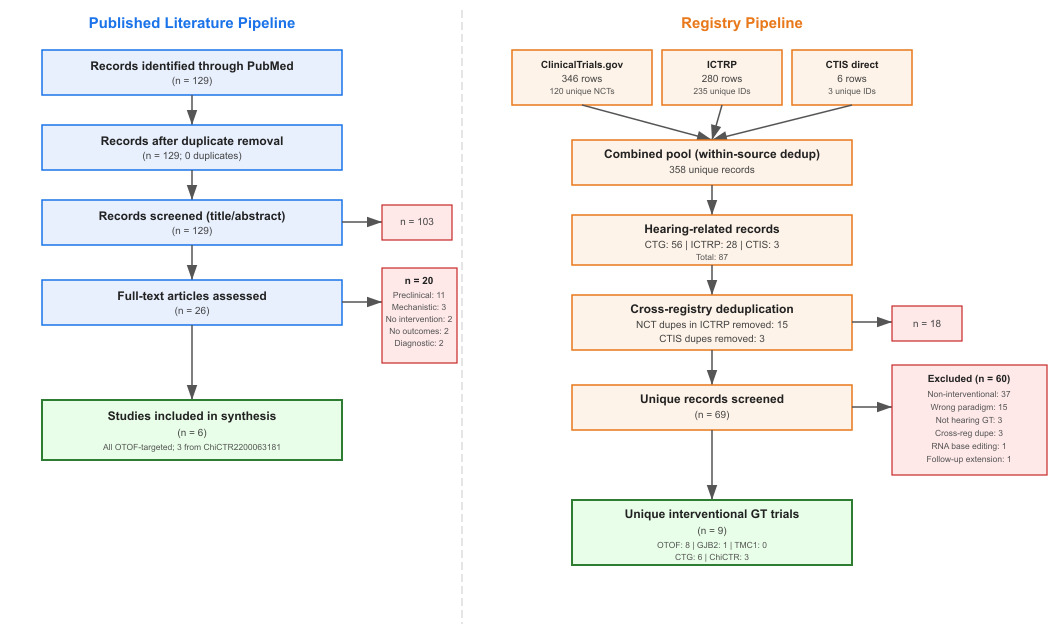
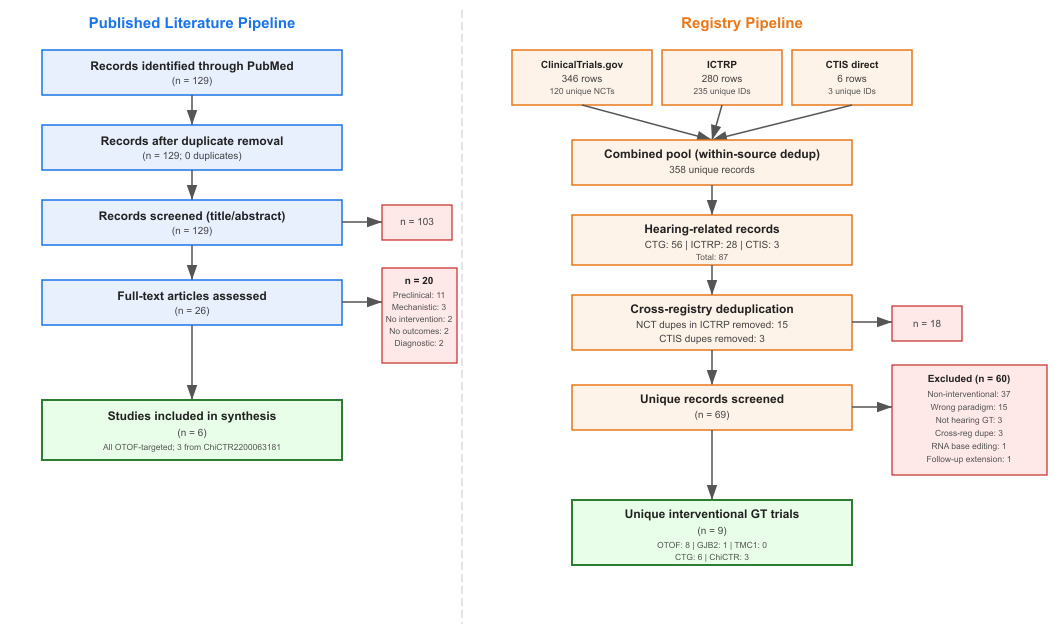
The PubMed search yielded 129 records. No duplicates were identified within the database results. All 129 records underwent title and abstract screening, after which 103 were excluded for reasons including irrelevance to human gene therapy for hearing loss, non-English language despite filter application, and topical misalignment (records pertaining to AAV biology in non-auditory systems captured by the broad search terms). Twenty-six full-text articles were assessed for eligibility (Table 2).
Of the 26 full-text articles reviewed, 20 were excluded for predefined reasons. The most common reason for exclusion was a preclinical-only study design, accounting for 11 of 20 exclusions. The remaining nine exclusions were distributed across mechanistic investigations without a therapeutic component, studies lacking a human intervention or reported auditory outcomes, and diagnostic or genetic characterization studies that did not involve gene delivery. The distribution of full-text exclusion reasons is presented in Table 3.
Six studies met all inclusion criteria and were carried forward into the qualitative synthesis. All six reported original human data from therapeutic gene transfer targeting OTOF-related deafness.
2.3.3. Registry-Derived Trial Landscape
Registry screening was conducted as a separate stream from the published literature pipeline. ClinicalTrials.gov yielded 346 records across 18 keyword queries, which reduced to 120 unique NCT numbers after within-source deduplication. ICTRP yielded 280 records across 15 keyword queries, reducing to 235 unique trial identifiers. Direct CTIS searches contributed 3 unique trial numbers across 2 export files. These raw counts and the results of within-source deduplication are summarized in Table 4. After topic-based filtering to retain only hearing-related records, 56 remained from ClinicalTrials.gov, 28 from ICTRP, and 3 from CTIS, producing a combined pool of 87 hearing-related records prior to cross-registry deduplication. Fifteen ICTRP records were identified as ClinicalTrials.gov duplicates by their NCT prefix, and 3 CTIS records duplicated entries already captured through ClinicalTrials.gov or ICTRP, yielding 69 unique hearing-related records for eligibility screening.
Application of the predefined inclusion and exclusion criteria to the 69 unique hearing-related records resulted in the exclusion of 60 records. The largest category of exclusion was non-interventional study design, which accounted for 37 records and included observational cohorts, natural history studies, patient registries, screening programs, and comparative audiology assessments without a gene therapy component. Fifteen records were excluded because they involved therapeutic interventions outside the scope of gene transfer or gene replacement as defined for this review, including cochlear implant evaluations, pharmacological agents, antisense oligonucleotides, stem cell therapies, and rehabilitation system development. Three records described gene therapy programs targeting conditions other than hearing loss (captured by the broad AAV search terms), and three additional records were resolved as cross-registry duplicates during the screening stage. One record involving RNA base editing for OTOF-related hearing loss was excluded on the basis of the predefined therapeutic paradigm boundary; this record had also been withdrawn by the sponsor. One record was excluded because it represented a long-term follow-up extension of an included parent trial with no new therapeutic administration. The full distribution of exclusion reasons is presented in Table 5.
Nine unique interventional gene therapy trials were retained for descriptive analysis, comprising six identified through ClinicalTrials.gov and three through ChiCTR (captured via ICTRP). No unique trials were contributed exclusively by the direct CTIS search; all CTIS records duplicated entries already captured through ClinicalTrials.gov or ICTRP.
The complete study selection process for both the published literature and registry pipelines is illustrated in Figure 1. The left pipeline maps the published evidence identified through PubMed. The right pipeline maps the registry-derived trial landscape identified through ClinicalTrials.gov, ICTRP, ChiCTR, and CTIS. The two pipelines were conducted as independent, parallel streams and are not merged at any stage. Registry records were screened manually to account for heterogeneity in record structure and indexing practices across member registries, and cross-registry deduplication was performed using trial identifiers (NCT, ChiCTR, and CTIS codes) to ensure that records registered in multiple systems were counted only once. A complete registry audit trail, listing the unique hearing-related records screened at the eligibility stage with trial identifier, source registry, title, intervention, gene target, recruitment status, and inclusion/exclusion decision with reason, is provided as Supplementary File 1.
2.4. Data Charting, Extraction, and Synthesis
For included published studies, data were extracted on publication year, country of origin, study design, sample size, age range, gene target, vector or platform type, delivery route, follow-up duration, auditory outcomes, and adverse events. Where multiple publications drew from the same trial registration, patient-level overlap was documented. For registry-derived trials, extracted variables included trial identifier, registry source, therapy designation, gene target, platform type, and recruitment status. Registry records were used descriptively and were not treated as equivalent to peer-reviewed efficacy evidence. Given the small number of published studies and heterogeneity of designs and outcome measures, results were synthesized narratively. Consistent with scoping review methodology, formal risk-of-bias assessment was not performed. The data charting form was piloted on the first two included publications and adjusted iteratively before being applied to the remaining studies and to the registry-derived dataset.
3. Results
3.1. Published Human Evidence
Clinical translation of OTOF-targeted gene therapy into human trials was supported by a substantial preclinical foundation, including AAV-mediated restoration of auditory function in mouse models of both TMC1-related genetic deafness and otoferlin-knockout deafness using single and dual-AAV delivery strategies.3–5 The six included studies are summarized in Table 6. All six targeted OTOF-related deafness, all employed AAV-based dual-vector systems to accommodate the approximately 6-kb OTOF coding sequence (which exceeds the approximately 4.7-kb packaging capacity of standard single AAV vectors10), and all used intracochlear delivery routes. Sample sizes ranged from 2 to 12 participants per study, and all interventional designs were single-arm, with the exception of one nonrandomized comparative cohort.
Three publications (Lv et al, Wang et al, and Cheng et al) drew participants from a single trial registration (ChiCTR2200063181) conducted at the Eye and ENT Hospital of Fudan University using the same AAV1-hOTOF dual-vector product. Lv et al reported the first six participants (unilateral injection)11; Wang et al reported five additional participants enrolled after a protocol amendment permitting bilateral administration12; and Cheng et al reported the gene therapy arm of a nonrandomized comparison at extended follow-up using the same 11 participants.13 The total number of unique participants across these three publications is therefore 11, not 22. Two further publications (Qi et al 2024 and Qi et al 2025) report sequential cohorts from a separate single-arm trial (NCT05901480) conducted by Otovia Therapeutics Inc. using a dual AAV-OTOF (Anc80L65 capsid) product; the 2024 case series describes the first two participants14 of the cohort subsequently expanded to ten participants and reported in 2025.15 The unique participant count across these two publications is therefore 10, not 12. The remaining publication (Valayannopoulos et al 2026) reports the DB-OTO trial (NCT05788536, Regeneron/Akouos)16 and contributes 12 unique participants with no overlap with the other programs.
3.2. Platform-Level Considerations
All six studies employed dual-AAV vector systems, in which the OTOF transgene is split across two AAV particles that recombine intracellularly. Within this shared framework, programs differed in capsid selection and promoter strategy. The approaches are summarized in Table 7.
3.3. Clinical Outcomes
Across all six studies, auditory improvement was consistently observed. This directional consistency is the most robust finding in the current evidence base, but it must be interpreted against the patient-overlap structure described above: three of six publications draw from a single trial cohort, so the apparent convergence is partly mechanical. In the earliest published trial, ABR thresholds improved by approximately 40 to 57 dB at 26 weeks.11 Subsequent reports showed clinically meaningful auditory gains, although different outcome measures were used. Wang et al reported that ear-specific average ABR thresholds, >95 dB in both ears at baseline, ranged from 50 to 85 dB at the latest reported assessment (26 weeks for patients 1–3 and 13 weeks for patients 4–5). Qi et al reported improvement in mean PTA from 106 ± 9 dB at baseline to 52 ± 30 dB after at least 6 months of follow-up.12,15 The multinational DB-OTO trial reported that 9 of 12 treated participants (75%) met the primary endpoint of a PTA of 70 dB HL or better at 24 weeks, with 3 participants achieving average normal hearing sensitivity.¹⁶
The magnitude of individual-level variability warrants emphasis. Across published trials, individual outcomes span a range of more than 90 dB, from no measurable improvement to normalized hearing.17 This heterogeneity is not well explained by available data, and understanding its determinants is a critical open question. A post hoc audiological characterization of 10 patients from the ChiCTR2200063181 cohort reported progressive improvements in ABR wave V latency and amplitude over the first year, consistent with ongoing auditory pathway maturation, and found that patients with prior contralateral cochlear implant experience exhibited more rapid neural responses.18
3.4. Short-Term Safety
Safety reporting across the six publications was uniformly described as favorable, with no dose-limiting toxicity, no treatment-related serious adverse events, and no participants discontinued for adverse events. A more disciplined reading separates this signal into domains that the current evidence can and cannot address.
Surgical delivery risks are inherent to intracochlear administration and overlap substantially with the established risk profile of cochlear implantation, including the use of general anesthesia in very young children and round window or stapes fenestration approaches. In the DB-OTO trial, 17 of 67 reported adverse events were attributed to the surgical delivery procedure, and two grade 3 serious adverse events occurred (mastoiditis in a contralateral implanted ear and walking instability), both of which resolved.16 The remaining programs did not report procedural complications attributable to the surgical route, although the small total of surgical exposures across all programs limits the statistical resolution of this assessment.
Vector-related and immune risks include responses to the AAV capsid and to transgene-expressing cells. In the three published Chinese trials, a pooled analysis identified 244 grade I/II adverse events and 2 grade III adverse events, with no detectable systemic T-cell activation against the capsid within the reported follow-up.17 Transient anti-otoferlin antibodies appeared in approximately half of DB-OTO participants and were generally undetectable by week 12.16 These observations are reassuring within their temporal window but do not address delayed humoral or cellular responses, and the implications for re-administration or contralateral treatment in patients who have already developed neutralizing antibodies are unresolved.
Auditory and vestibular risks include transient threshold shifts, perilymphatic disturbance from injection volume, and potential effects on residual outer hair cell function. Transient reductions in distortion product otoacoustic emission signal-to-noise ratios have been reported in the immediate post-injection period in the Fudan/Refreshgene cohort, with partial recovery during follow-up; these have been attributed to procedural rather than vector-related causes but have not been systematically characterized across programs. Vestibular outcomes were not consistently reported.
Device-related confounding warrants explicit acknowledgment in the subset of participants with concurrent or prior cochlear implantation. Cheng et al directly compared gene therapy against cochlear implantation in a nonrandomized cohort,13 and the DB-OTO program enrolled at least one participant whose contralateral ear contained a cochlear implant.16 The presence of implants in the contralateral ear introduces interpretive complications for both auditory outcome measures and safety attribution, particularly for adverse events that could plausibly be attributed to either the implant or to the gene therapy administration.
Long-term safety remains substantively unaddressed. Follow-up durations across the published evidence range from approximately 1 to 12 months, which is insufficient to evaluate outcomes of genuine concern over a patient’s lifetime: persistence of viral vector sequences in cochlear tissue, durability of transgene expression, potential for delayed immune responses to viral capsid proteins19,20 and long-term structural consequences of intracochlear injection in developing auditory and vestibular systems. The absence of early harm is necessary but not sufficient as an indicator of long-term safety, particularly in young pediatric populations exposed to viral vectors during a developmentally sensitive period.
3.5. Registry-Derived Trial Landscape
The registry search identified 632 records across ClinicalTrials.gov, ICTRP, ChiCTR, and CTIS prior to screening and deduplication. Following within-source deduplication (358 unique identifiers), topic-based filtering (87 hearing-related records), cross-registry deduplication (removing 18 duplicates), and eligibility screening (applying criteria to 69 provisionally deduplicated records entering screening; three additional cross-registry duplicates were identified during screening), nine unique interventional gene therapy trials were retained (Table 9).
Of the nine trials, eight target OTOF-related deafness, spanning programs registered across the United States, China, and Europe. The remaining trial (ChiCTR2500111936, evaluating EHT201) targets GJB2-associated hearing loss and represents the only currently registered interventional program extending beyond the OTOF biological niche. No interventional trials targeting TMC1 were identified in any registry source.
4. Discussion
The central tension in this field lies between a narrow but coherent published evidence base and a broader, rapidly evolving clinical development landscape that the literature alone does not capture. The six published reports provide early evidence that gene replacement targeting OTOF-related deafness can produce clinically meaningful improvements in auditory function. At the same time, the registry data make clear that the field has already moved beyond the published evidence, with nine registered interventional gene therapy trials identified across multiple regulatory settings and vector platforms, with limited expansion beyond OTOF to additional genetic targets.
Considered on its own, the published record appears narrow and potentially premature as a basis for broad clinical conclusions: small samples (approximately 33 unique participants across three independent clinical programs, with two of those programs contributing sequentially reported overlapping cohorts), short follow-up, single-arm designs, and a single genetic target. Considered alongside the registry data, however, the picture is one of a field in clinical transition, moving from proof-of-concept in a controlled and favorable biological context toward early-stage expansion across multiple programs.
The near-exclusive concentration of both published and registry-derived evidence on OTOF-related deafness deserves careful analysis. The underlying pathology involves disruption of otoferlin-dependent synaptic vesicle exocytosis at the inner hair cell ribbon synapse, which impairs sound encoding while leaving hair cells intact, afferent neural connections functional, and the broader cochlear architecture undisturbed.6 Under these conditions, restoring a single missing protein can rescue an otherwise intact system. That context contrasts sharply with the biology of other major hereditary hearing loss subtypes.
GJB2-related deafness, which accounts for a substantial proportion of congenital nonsyndromic hearing loss globally, involves disruption of connexin 26 in cochlear gap junctions, impairing the potassium recycling that sustains the endocochlear potential.21 This is a system-level metabolic disturbance rather than a localized functional deficit, and the resulting pathology may involve early or progressive structural compromise of the cellular substrate. Only a single interventional gene therapy trial targeting GJB2 was identified (ChiCTR2500111936). Its results will be particularly informative for understanding whether the favorable biology of OTOF can be replicated in a structurally more complex genetic context.
TMC1-related hearing loss presents a different set of constraints. TMC1 encodes a critical component of the mechanotransduction channel in cochlear hair cells22,23 and gene replacement strategies have shown functional restoration in preclinical models.3 The challenge is one of timing: in mouse models of TMC1-related deafness, hair cell function is progressively lost over early postnatal development, and the therapeutic window for effective gene replacement appears to be narrow, though the precise translation of this window to human cochlear development has not been conclusively established. The absence of any registered interventional TMC1 trials is consistent with these constraints.
The biological explanations advanced above are plausible and consistent with available preclinical and clinical evidence, but they should be marked as interpretive rather than established. Target underrepresentation in the trial landscape may also reflect non-biological factors, including commercial strategy, intellectual property considerations, vector design constraints, regulatory risk tolerance, and the practical feasibility of trial enrollment for ultra-rare genetic subtypes. Biological tractability is a necessary but not sufficient explanation for the observed asymmetry, and the absence of TMC1 trials in particular may be attributable in part to factors not visible from the registry data alone.
The rapid expansion of the OTOF clinical pipeline introduces its own interpretive challenges. With multiple independent programs advancing under different regulatory frameworks and testing related but distinct therapeutic products, the risk of generating a fragmented dataset is substantial. The current evidence base includes ABR thresholds, pure-tone averages, speech perception assessments conducted with varying instruments, and sound localization measures, none of which have been harmonized into a common reporting framework. Without such consensus, cross-trial comparison will remain limited even as the number of trials grows.
The field’s trajectory is one of a transition that is well underway but far from complete. What the field now needs is methodological consolidation: agreement on outcome standards, longer follow-up in existing trials, systematic expansion beyond OTOF into biologically tractable alternative targets, and a rigorous framework for evaluating the relationship between timing of intervention and therapeutic outcome.24
5. Limitations
Several limitations of this review should be acknowledged. The published evidence base is restricted to a small number of early-phase studies originating from three independent clinical programs, with overlapping cohorts across sequential reports within two of those programs, limited sample sizes, and short follow-up durations, all of which constrain the robustness and generalizability of conclusions. The bibliographic search was limited to a single database (PubMed), which may have resulted in the omission of studies indexed exclusively in EMBASE, Cochrane CENTRAL, Scopus, Web of Science, or regional databases. This limitation was partially mitigated by systematic registry searches across four platforms, but the review is appropriately framed as a PubMed-based scoping review rather than as a comprehensive multi-database evidence synthesis. Title and abstract screening was conducted by a single primary reviewer, with independent verification by a second reviewer at the full-text and registry stages. While inter-reviewer agreement was high and disagreements were resolved without third-reviewer adjudication, the absence of dual independent screening from the initial title-and-abstract stage represents a residual methodological limitation. Grey literature, including conference proceedings, preprints, and industry communications, was not systematically searched. This decision was made to maintain a clear evidentiary distinction between peer-reviewed and formally registered evidence, but it may result in the omission of recent data not yet available through either of those channels. This constraint is most consequential for the DB-OTO program, for which longer follow-up data have been disclosed through conference presentations and sponsor communications but not yet incorporated into the peer-reviewed record captured by the present search; this constraint also bears on regulatory developments postdating the search window. Registry-derived data were incorporated as a complementary source, but registry entries vary in completeness, are subject to retrospective amendment, and reflect stated intentions rather than published findings. Heterogeneity in outcome measurement across studies precluded quantitative synthesis and limits the interpretive precision of the narrative analysis. No protocol for this scoping review was prospectively registered, which is noted in the interest of transparency and acknowledged as a deviation from PRISMA-ScR best practice.
6. Conclusion
Gene therapy for hereditary hearing loss has produced early human data consistent with meaningful auditory improvement within a single, biologically favorable genetic subtype, though the evidence remains limited in size, follow-up duration, and genetic scope. The six published human studies demonstrate what has been shown rather than what has been established: a reproducible directional signal in OTOF-related deafness, generated across three independent clinical programs treating approximately 33 unique participants in total, using closely related dual-AAV platforms, with participant-level overlap across several publications within two of those programs. Registry data document continued expansion of clinical development, with nine registered interventional gene therapy trials across multiple regulatory settings, though registry activity reflects institutional commitment rather than confirmed therapeutic benefit. The concentration of both published and registered evidence on OTOF reflects translational constraints that the available data do not resolve, with biological tractability a necessary but not sufficient explanation. Long-term safety, durability of transgene expression, determinants of individual variability in response, and translatability to other genetic subtypes remain open questions that published short-term outcomes cannot answer. Establishing whether early improvements persist, whether they generalize beyond OTOF, and whether the current platform designs are the right ones for structurally more complex forms of hereditary hearing loss will depend on longer follow-up in existing cohorts, completion of trials targeting alternative genes such as GJB2, and the emergence of independently replicated data across regulatory jurisdictions. The present evidence base supports continued investigation; it does not yet support broader clinical conclusions.
Note Added in Revision
Searches reported in this review closed on April 17, 2026, prior to subsequent regulatory developments. On April 23, 2026, the U.S. Food and Drug Administration granted accelerated approval to Otarmeni25 (lunsotogene parvec-cwha), the dual-AAV gene therapy formerly designated DB-OTO and corresponding to the Valayannopoulos et al (2026) report included in this review (NCT05788536), for pediatric and adult patients with severe-to-profound and profound sensorineural hearing loss associated with molecularly confirmed biallelic variants in the OTOF gene, preserved outer hair cell function, and no prior cochlear implant in the same ear. This represents the first regulatory approval of an inner-ear gene therapy for a hereditary hearing loss subtype. The substantive findings of the present review, including the concentration of human evidence within OTOF-related deafness, the overlap of cohorts across sequential publications within individual clinical programs, the short follow-up of available data, and the narrow target representation across the registry landscape, remain unchanged by this development. The framing of the field as wholly pre-approval no longer applies for the OTOF subtype, although the broader landscape of hereditary hearing loss remains without a disease-modifying therapy.
ACKNOWLEDGMENTS
The author thanks Dr. Mohammad Odeibat for independent verification of full-text and registry inclusion decisions.
CONFLICT OF INTEREST / COMPETING INTERESTS
The authors declare no conflicts of interest relevant to this work.
ETHICS APPROVAL AND CONSENT
This study was a scoping review of publicly available published literature and clinical trial registry records. It did not involve the recruitment of human participants, the collection of identifiable personal data, or any new intervention involving humans or animals. Therefore, institutional ethics approval and informed consent were not required.
AI TOOL USE DISCLOSURE
Generative artificial intelligence tools were used to assist with language editing. The authors reviewed, verified, and revised all AI-assisted content and take full responsibility for the accuracy, integrity, interpretation, and final presentation of the work. Artificial intelligence tools were not used to determine study eligibility, extract data, analyze findings, or make final methodological or interpretive decisions.
THIRD-PARTY MATERIAL PERMISSIONS
All tables and figures were created specifically for this manuscript. No third-party copyrighted material requiring permission has been reproduced or adapted.
DATA AVAILABILITY
All data analyzed in this review were obtained from publicly available published articles and clinical trial registry records. The data supporting the findings are presented within the manuscript and its supplementary materials. The complete registry screening and eligibility audit trail is provided in Supplementary Table S1. No additional participant-level dataset was generated.
FUNDING
No funding was received for the preparation of this manuscript.
REPORTING GUIDELINES
This scoping review was conducted and reported in accordance with the Preferred Reporting Items for Systematic Reviews and Meta-Analyses Extension for Scoping Reviews (PRISMA-ScR).
PREPRINT DISCLOSURE
This manuscript has not been posted as a preprint and has not been previously published.